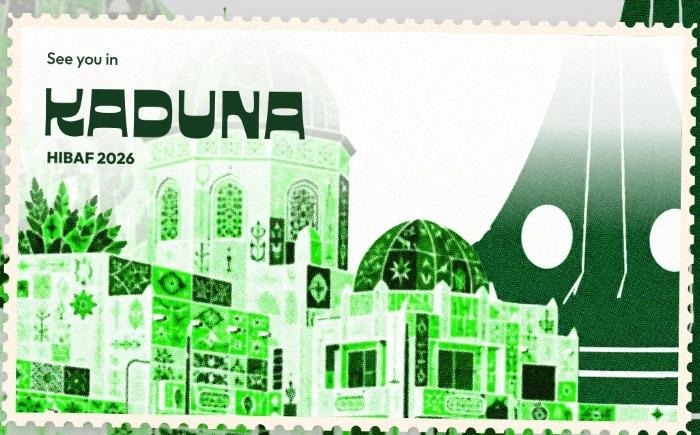
The festival opened in London on 24th October 2026, in collaboration with the School of Oriental and African Studies (SOAS), University of London, and the #HIBAF26 bus continues to Kaduna on 4th and 5th December 2026, the traditional home of the festival, and concludes in Abuja on 11th December 2026, in partnership with Institut Francais, Nigeria.
Curated by Open Arts Development Foundation, the Hausa International Book and Arts Festival (HIBAF) will present its sixth edition under the theme ‘Afrophony/Hausa Philosophies’, with a programme of panel discussions, film screenings, exhibitions, workshops, book chats, poetry performances and live music.
Afrophony/Hausa Philosophies
The 6th edition of HIBAF turns its attention to African languages as spaces of intellectual, artistic and philosophical production. Across the continent, languages have carried generations of ideas about society, morality, identity, relationships and the world. Yet the ways African thought enters global conversations continue to be shaped largely through European languages. Literature, philosophy, and cultural production from Africa are often encountered through English, French and Portuguese, leaving the languages in which much of this thinking actually takes place at the margins.
Afrophony offers a way of thinking about this linguistic landscape differently. HIBAF 2026 considers African languages as languages that produce knowledge in their own right.
This year’s theme asks what becomes visible when African-language thought is allowed to remain rooted in its own linguistic and cultural contexts, and what kinds of ideas, philosophies and forms of expression might be lost when they are understood only through translation?
Hausa provides the festival’s point of departure for this exploration. As one of Africa’s most widely spoken languages, Hausa has developed a rich and varied literary and cultural ecosystem spanning oral traditions, print, Ajami, market literature, radio, film, music and digital platforms. Its intellectual life has never been confined to formal institutions. Ideas about ethics, faith, social life, gender, power, love and modernity have circulated through stories, poetry, popular literature, everyday speech and other forms of cultural expression.
Hausa popular literature, particularly the romance fiction written and read largely by women, offers one example of how these forms can become sites of serious social thought. Through popular genres, writers and readers have negotiated questions of desire, morality, religion, gender, censorship and changing ideas of modernity. From market stalls and handwritten booklets to mobile phones, Facebook and WhatsApp, Hausa literary publics have continually developed new ways of producing, sharing and debating ideas.
HIBAF 2026 will explore these forms of knowledge alongside wider questions about African-language literary and intellectual traditions. How do African languages generate concepts that may resist easy translation? What happens to African-language literature when it enters colonial and contemporary archives? Can digitisation create new possibilities for the preservation and circulation of African languages? And how can the infrastructures that sustain African-language creativity respond to the changing ways people read, write and communicate?
The Panels We’re Already Excited About
The festival’s programme of panels and conversations will bring together writers, scholars, artists, cultural practitioners and other thinkers to explore the questions at the centre of Afrophony/Hausa Philosophies. Across the three locations, these discussions will consider African-language literary and intellectual traditions, the possibilities and limits of translation, and the ways language shapes how knowledge is produced, shared and understood.
Among the conversations, attendees to HIBAF will encounter “Rayuwar Hausawa a London,” exploring the experiences, identities and cultural lives of Hausa communities in the diaspora. “The Bori Spirits,” will examine Bori as a spiritual and cultural tradition and its place within Hausa knowledge systems.
“Falsafar Hausawa Jiya da Yau,” will explore how Hausa philosophies and Afrophony have evolved, what they represent today, and how these knowledge systems can be sustained into the future.
Together, these conversations invite audiences to engage critically with Hausa intellectual traditions, contemporary African-language thought and the ways knowledge travels across languages, generations and geographies.
Official Selection
Film Screening
HIBAF26’s official film screening will feature Uromi 16: The Story, produced and directed by Sa’id Sa’ad and Musa Gwary respectively. The film documents a jungle justice incident in Nigeria, confronting audiences with an important and difficult story about violence, justice and the consequences of collective action.
Curated by Salma Ja’eh
Exhibition
The Inside Out / Ciki da Waje exhibition, curated by Salma Ja’eh, brings together multidisciplinary works exploring the relationship between interior and exterior spaces, identity and lived experience. The exhibition will sit alongside the festival’s conversations, screenings and performances, extending HIBAF’s exploration of African-language thought beyond the spoken and written word and into visual, material and audio forms.
Live Stage
Poetry Performances / Live Music
HIBAF is set to captivate audiences with an exciting programme of music and poetry. Audiences can also look forward to a captivating poetry theatre production.
Partners and Sponsors
HIBAF26 is made possible with the generous support of Open Society Foundations, alongside our other partners, including the Litar Foundation, Institut Francais Nigeria and Center for African Studies at SOAS, London.
Venues
SOAS London
October 24, 2026
Banquet Hall, Arewa House, Kaduna, Nigeria
4 and 5 December 2026
Institut Francais, Abuja, Nigeria
11 December 2026
Registration
Online registration for this year’s festival has started. Attendees can register on the festival’s website at www.hausabaf.com or come to the venue to register and attend.
Press Pass
Welcome to the Hausa International Book and Arts Festival Communications Desk.
For up-to-date and late-breaking information, please visit our website or follow us on Instagram, X, Facebook and TikTok.
Journalists, photographers, media personnel and independent bloggers who would like to cover the events and activities at HIBAF can reach out for a Press Pass. For all press and media-related enquiries and requests, please email Salma Ja’eh at info@openartsworld.org.